Passmore
The Artist
Colin Passmore
“The true charm lies in the ability to transport you right into the midst of Australian nature.”
Born and educated in Western Australia, Colin Passmore relocated with his young family to Noosa, Queensland in 1982. He began exhibiting his work in 1983, quickly gaining acclaim from Australia's top galleries and art critics.
Passmore's career has been gaining momentum over more than 35 years. He has exhibited in nearly every city of Australia, and his works have found their way to collectors in the U.S.A., Canada, England, Hong Kong, Singapore, The Middle East, New Zealand and Holland, as well as many corporate and private collections across Australia.
In 1986, Passmore was commissioned to produce 50 oil paintings for the Seahaven Resort in Noosa — a pivotal moment that cemented his reputation. Many more commissions followed, and some of his most creative breakthroughs have evolved through the development of site-specific works for designers and private clients who have given him the support and freedom to push boundaries.
His best known works are the Australian Outback Desert Series alongside the celebrated Paperbark Series, though he continually experiments with various media and imagery to satisfy his need for new and exciting working methods.
Based In
Noosa, Queensland, Australia
Active Since
1983
Medium
Acrylic & Mixed Media on Canvas
Known For
Paperbark Series, Outback Desert Series, Coastal Imagery
Representation
Wentworth Galleries
Studio One Noosa
Technique
Process & Practice
The Method
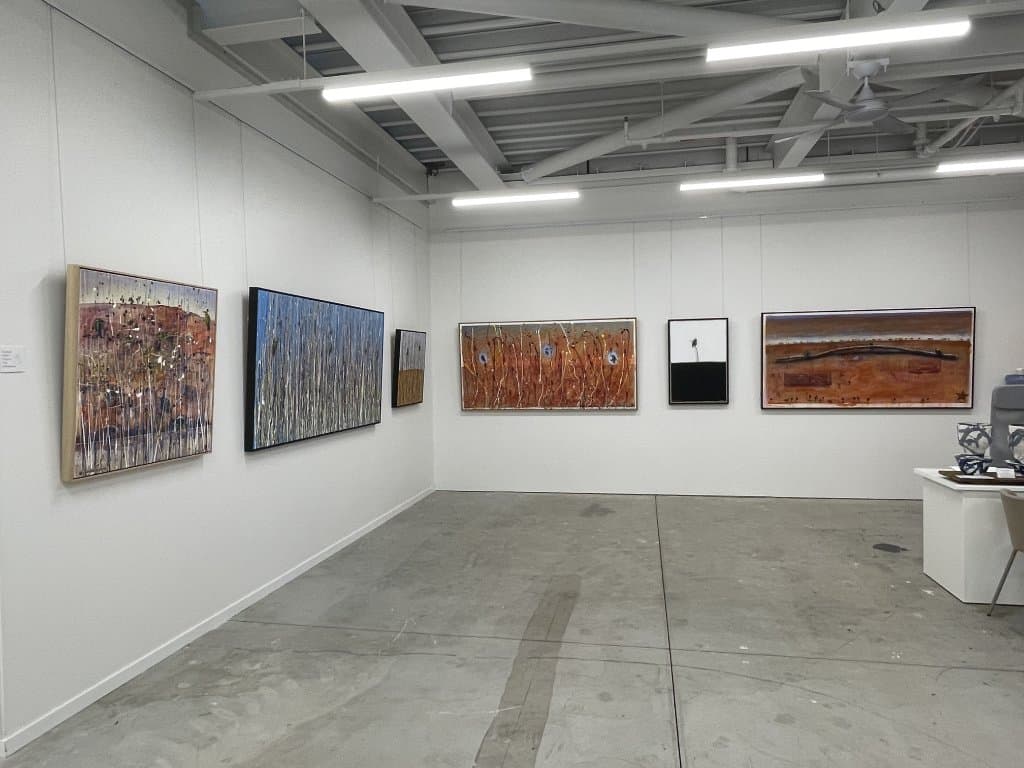
Looking at Colin Passmore's paintings gives a viewer an almost mischievous feeling — as if observing the scene from a hidden vantage point, peeking through a thick growth of trees or weeds. Behind them sometimes hides a mountain range or a calming lake.
Instead of focusing on the subject past the tangle of flora, Passmore elaborates on the texture of the trees and weeds themselves, and on what hides within the maze of branches. He brings to the forefront small birds, dainty flowers and lily pads, studies the structure of the tree bark, or individual blades of grass growing close to the lake.
His rendition of nature is reminiscent of Jackson Pollock's drips on canvas, yet clear motifs always emerge. He cleverly works with negative space, leaving out important parts of compositions to create a striking contrast between rich detailing and large areas of white.
The myriad of small details provides an almost audible, immersive experience. One can imagine sitting in nature, hearing the buzzing vibrato of insects hiding in the grass, or lovely birdsong.
Acquire a Work
Interested in a particular piece?
Reach out directly to enquire about availability and pricing, or visit the Galleries page to find a representative near you.